


Document date and review schedule
Date of this version: July 2026.
Date by when this must be reviewed and any updates made: July 2027.
Introduction
The DofE is committed to providing a safe environment for everyone who participates in or comes into contact with our organisation and its activities. These procedures must be followed where there are safeguarding concerns about a child or an adult.
These procedures are part of the DofE safeguarding framework and should be implemented with reference to our Safeguarding Policy Statement and related policies.
This procedure sets out the steps to be taken in response to any concern that a child or adult at risk may be experiencing or is at risk of harm or abuse. It also includes procedures about what to do if you have concerns for yourself e.g., if you are a young person.
If you have immediate concerns for the safety of yourself or others call 999.
At any time: if you are a child (under 18) and you need help, you can call Childline on 0800 11 11 for help, advice and support.
How to use these procedures
These procedures are set out in two sections and set out what you must do if you have a concern.
Section one: Reporting concerns
Anyone may report concerns using this procedure
- DofE staff and volunteers
- Participants or their parents / carers
- Licensed organisations (LOs and AAPs)
- Others such as members of the public
Note regarding Licensed Organisations
All organisations licensed by the DofE to deliver its programme of activities are mandated to have effective safeguarding arrangements in place.
As part of the licensing contract terms, LOs and AAPs must report certain safeguarding concerns, incidents and allegations direct to DofE DSL, [email protected], without delay.
- If you are a participant, their parent/carer or other person (i.e., NOT a DofE member of staff or volunteer) and you have concerns about an LO or AAP, you should usually follow the LO or AAP’s safeguarding procedures and contact their safeguarding lead in the first instance. However, we encourage you to let us know about your concerns, particularly if you feel you are not being listened to, the concern is not being addressed or the matter is serious in nature. On receipt of your safeguarding concern we will ask you whether this has been reported to the LO or AAP.
- If you are a staff member or volunteer in an LO or AAP, you must follow your organisation’s safeguarding policy in the first instance. However, to enable DofE to satisfy itself regarding the safeguarding of its participants, we want you to tell us if you think you are not being listened to or the concern is not being addressed.
Section Two: applies to the Designated Safeguarding Lead and sets out steps following receipt of a safeguarding concern
The procedures are presented in flow charts and text. Please refer to both for complete information.
Section one: Reporting concerns
This section applies to everyone who wishes to raise a safeguarding concern.
If you or the person concerned are in immediate danger or need immediate medical assistance contact the emergency services 999 first.
If you or someone you know, is experiencing harm or abuse whilst participating in DofE activities, please contact the DofE safeguarding team by emailing [email protected] or call 01753 727400.
If you prefer, you can tell a DofE member of staff or volunteer and they will assist you in raising the concern with us.
If the person you want to report is the DSL or DDSL, or you think they have a conflict of interest, then you should contact the DofE’s Chief Executive Officer or the Trustee Board.
You can also contact the Police, NSPCC (for children), the relevant Social Services team, your doctor or other organisations that can provide information and give help and support (see Appendix 2 Other sources of support).
On being told of a safeguarding concern, the DofE will follow the procedure set out in section two of this document. If you do not think DofE have addressed your concerns in the way that they should be please contact the Charity’s Chief Executive Officer.
If you are a participant, parent/carer or member of public you are welcome at any stage to have someone support you. It is important you can tell us what happened and what you want to happen.
DofE want to ensure that whether you are a participant, parent/carer or other person that you feel you can take part in our activities or work with us, safely.
We will take all reasonable steps to support you to do that.
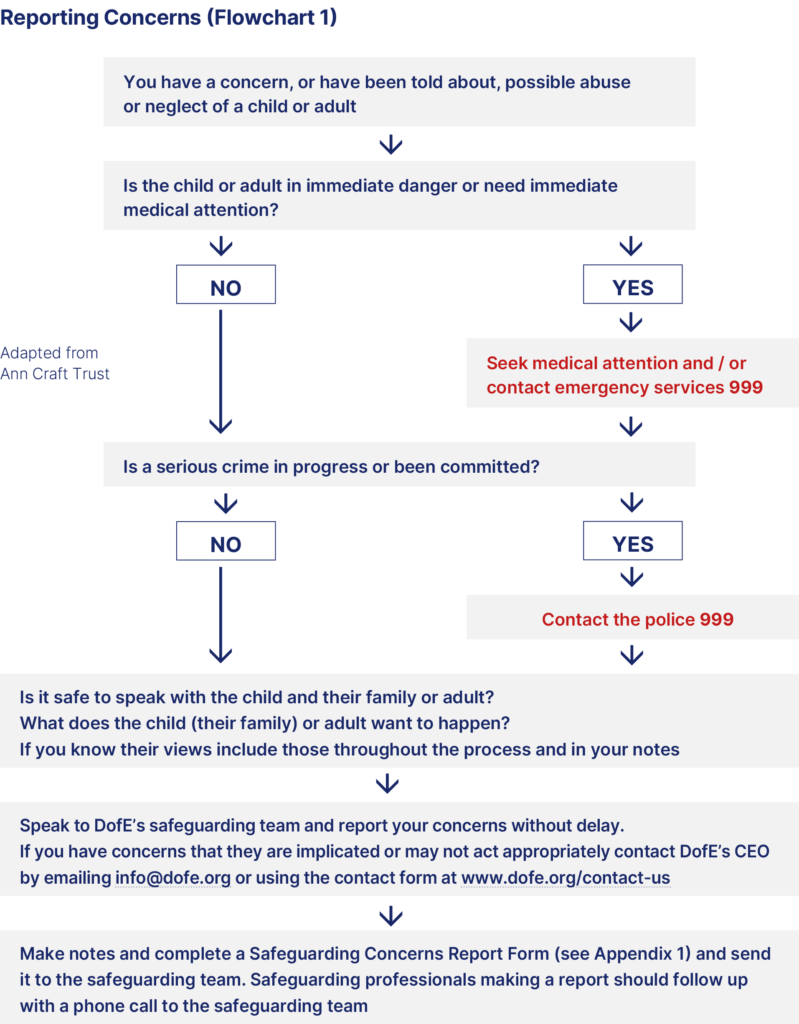
Reporting concerns
You should never keep safeguarding concerns to yourself. If you have concerns and/or you are told about possible or alleged abuse or neglect or poor practice, you must contact the DofE safeguarding team as soon as you can.
You may be concerned about abuse or harm that has happened (or that may happen) to a child or adult. This might be because of something you have seen or heard, information you have been told by others or because someone has confided in you about things that are happening or have happened to them.
If the Designated Safeguarding Lead is the person you want to report or you think they have a conflict of interest, then report to the DofE CEO.
Where you have concerns about someone, always follow the guidance below:
- It is not your responsibility to prove or decide whether a child or adult has been harmed or abused. It is everyone’s responsibility to respond to and report concerns they have
- If someone has a need for immediate medical attention call an ambulance on 999
- If you are concerned someone is in immediate danger or a serious crime is being committed contact the police on 999 straight away. Where you suspect that a crime is being committed, you must involve the police
- It is important to be person-centred. Provided it will not put a child or adult or you at further risk, discuss your safeguarding concerns with the child (and parents/carers, if possible) or adult and ask them what they would like to happen next. Explain to them that you have to pass on your concerns to your Designated Safeguarding Lead. Do not contact the child, their parents/carers or the adult before talking to the DSL if the person allegedly causing the harm is likely
to find out - Remember not to confront the person thought to be causing the harm.
Responding to a direct disclosure
If a child or adult tells you or their behaviour suggests that they are being harmed or abused, or information is received which gives rise to concern, you should:
- Stay calm
- Take it seriously
- Listen carefully to what is said, allowing the person to continue at their own pace
- Be sensitive and non-judgemental
- Keep questions to a minimum and only to clarify what they are telling you. Use TED (tell me, explain to me, describe to me) so that you avoid asking leading questions
- Reassure the person that they have done the right thing in revealing the information
- Ask them what they would like to happen. You cannot make promises but it is important to know someone’s views, feelings and wishes
- Explain what you need to do next
- Explain that you will have to share the information with the DSL
- If they are an adult and it is NOT an emergency, ask if they are willing for the information to be shared outside the organisation (i.e., do they consent to DofE telling the police or local authority)
- Make an arrangement as to how you or the DSL can contact them safely
- Provide relevant information so they know how to get help or contact other organisations for advice and support (e.g., Police, Domestic Abuse helpline, Victim Support – see Appendix 2)
- Act swiftly to report and carry out any relevant actions
- Record in writing what was said using the child or adult’s own words as soon as possible
- Keep the record securely so that no unauthorised person sees it.
It is important not to:
- Promise to keep the information secret – you will have to tell the DSL as they may need to tell the police or local authority
- Dismiss or ignore the concern
- Panic or show shock
- Make negative comments about the alleged perpetrator
- Make assumptions or speculate
- Come to your own conclusions
- Probe for more information than is offered
- Make promises that cannot be kept
- Conduct an investigation of the case
- Confront the person thought to be causing harm
- Take sole responsibility.
Record keeping
- Complete a Safeguarding Report Form (see Appendix 1) and submit to the DofE safeguarding team without delay and within 24 hours where possible
- Staff can also submit reports using the reporting function in the CRM
- You should also phone ahead to make sure they are expecting the form and to discuss any immediate concerns or actions
- Describe the circumstances in which the concern came about and what action you took/advice you gave
- It is important to distinguish between things that are facts, things that have been observed or overheard and opinions, in order to ensure that information is as accurate as possible
- If someone has told you about the harm or abuse, use the words the person themselves used. If someone has written to you (including by email, message) include a copy of this with the form or forward separately if reporting via the CRM.
Confidentiality and information sharing
You must always take care to treat information as confidential at all times and in line with data protection best practice. This means being careful what you share verbally and in writing.
Data protection must never be a barrier to safeguarding. Always share your concerns with the Safeguarding team who will decide what steps need to be taken.
Information must only be shared with those who need to know such as the DSL and safeguarding professionals. The Safeguarding team will provide advice and support regarding this in each case.
Arrangements for information sharing between DofE and other organisations is provided for in the relevant documentation e.g., licensing contract documents (Licensed Organisations) or joint working protocols (joint working).
Section two: Steps for the DofE DSL
Procedure for Designated Safeguarding Lead (Flowchart 2)
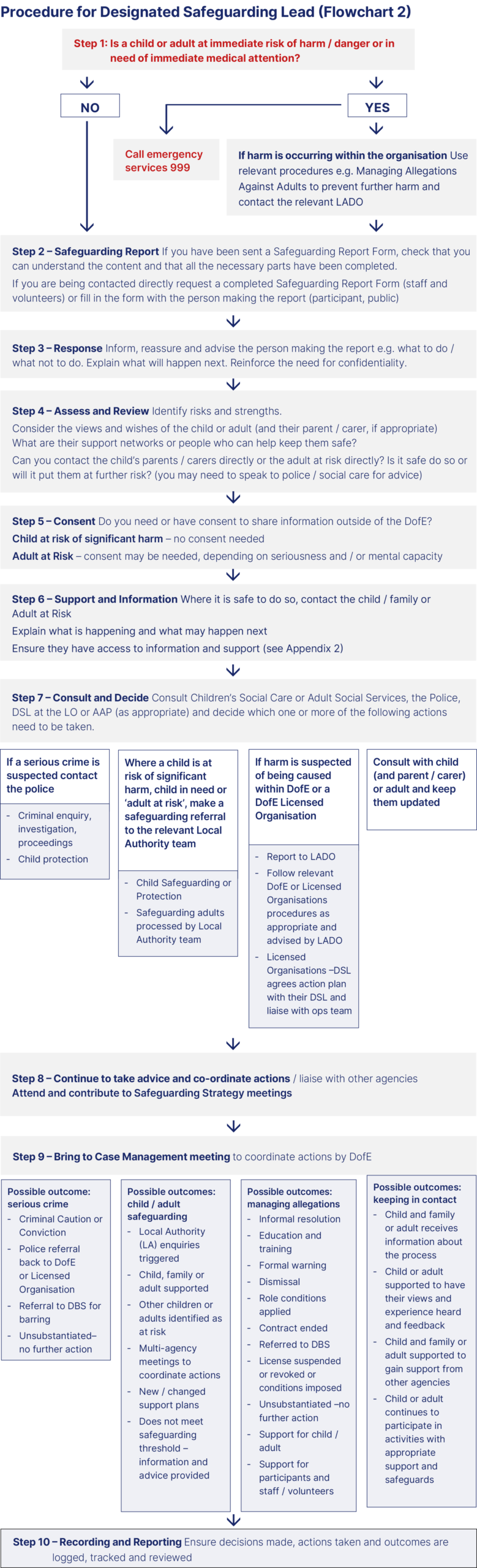
Once a concern has been passed to the DofE safeguarding team, they will coordinate this procedure (see Flowchart 2 above), having due regard to the facts known. Each case will be treated on a case-to-case basis.
The safeguarding team will keep clear records of decision making, actions taken, and the outcomes achieved. They will track progress and report regularly via case management meetings. They will also collect feedback from the child, their parent/carer or adult concerned and any Licensed Organisation or Approved Activity Provider involved.
The safeguarding team in consultation with others such as DofE DSL, DofE Safeguarding Board chair, police, LADO, social care (as appropriate) will take the following actions:
Immediate response
1. Ensure that all immediate actions necessary to safeguard anyone at risk have been taken. This may mean calling emergency services.
Where the incident or risk is in relation to the behaviour of a DofE staff member or volunteer, use the relevant procedures (e.g. Managing Allegations Against Adults) to prevent that person making contact with the child or adult at risk.
Where the incident or risk is in relation to activities delivered by a Licensed Organisation (LO or AAP), the safeguarding team must ensure that the safeguarding lead of that organisation is made aware (if they are not already) and agree an action plan.
In most circumstances it will be appropriate for the licensed organisation safeguarding lead to be responsible for actions and keep the DofE safeguarding team up-to-date. However, where the safeguarding team, in agreement with the DSL, feels that appropriate action has not been taken, they may (in line with the licensing arrangements and DofE Safeguarding Policy), take action themselves.
The safeguarding team, in agreement with the DSL, will consider all known or reasonable risks when deciding immediate action and next steps. In the case of Licensed Organisations, this will include liaising with the relevant DofE Country team regarding any necessary steps or conditions that should be imposed, monitored and/or recorded regarding that organisation and its delivery of DofE programme.
Next steps
2. If you have been sent a Safeguarding Report Form check that you can understand what is written and that all the necessary parts have been completed.
If you are being contacted directly by a DofE member of staff or a volunteer or other professional, request that they complete a Safeguarding Report Form if they have not already done so (see Appendix 1) as soon as possible.
If the report is being made by the child or adult themselves or a member of the public, fill in the safeguarding report form yourself, gaining the details with the person contacting you.
3. Inform, reassure, and advise the person making the report e.g. what to do/what not to do. Explain what will happen next. Reinforce the need for confidentiality. It may be hard for people to understand, but make sure they know it is not always possible to let them know the outcome of their report because you must protect the privacy of others. Reassure them that they have done the right thing.
4. Consider what is known about the situation, what the risks are, what is known of the views of the child, their parent/carer (where appropriate) or the adult.
Also think about any known strengths such as support networks or places the child or adult goes (e.g., school, club), relationships or other factors that will be helpful to keep them safe.
It is important that in taking steps to safeguard someone, that this does not place them at greater risk. In some cases, talking to a child’s parent or carer or the adult’s partner for example may increase risk, especially if that person is suspected of either perpetrating or covering up the abuse. If you are unsure, you can contact the children’s social care, NSPCC (children) or adult social services team (adults) for advice.
Decide if you need to contact the LO or AAP, child (and parent/carer) or adult to get more information, determine their wishes, or explain what actions you need to take.
5. Establish whether you need consent to share the information outside of the DofE (see also step 7).
The general principle is that
- Where a serious crime has been committed or where there is imminent and serious risk, the matter must be reported to the police regardless of whether consent has been given by the child’s parents/carers or the adult at risk
- Where there are concerns that a child is at risk of significant harm, a referral to children’s services must be made (police may also need to be informed). This is regardless of whether the child’s parents/carers consents or where there is an adult at risk and they do not consent.
You should seek consent for:
- a referral to children’s social care because you believe a child to be a child in need or requires early help. You can check the local authority child safeguarding guidance and thresholds for information or contact the children’s social care team for advice
- a referral to adult social services in respect of an adult at risk. This is unless one of the above exceptions applies or there is reason to believe the person lacks the mental capacity to make a decision regarding the safeguarding situation.
Advice can and should be sought from the local authority adult safeguarding team regarding mental capacity. Further information and guidance about mental capacity can be found in Appendix 3.
6. Explain to the child (and their parent/carer, where appropriate) or adult about the process and what will happen next. Ensure that they have been provided with information about who to contact for help or other organisations that can support them (see Appendix 2).
ONLY do this if you have a way of safely contacting them which does not place them (or yourself) at risk.
7. Consult and decide.
If necessary, consult with relevant persons such as DofE Safeguarding Board chair, the police, LADO and relevant local authority safeguarding team, the safeguarding lead of the Licensed Organisation (where relevant) to decide which of the following actions need to be taken and by whom:
- Contact the police (where the crime took place) if
- a serious crime has been committed
- a crime has been committed against someone without the mental capacity to contact the police themselves
- the child or adult has asked you to make a report to the police on their behalf because they are unable to themselves
- Make a referral to the Children’s Social Care team (in the local authority where they live) where
- a child is at risk of significant harm. This includes all situations where there is domestic abuse within the household where the child lives
- a child is in need or requires early help (consent is required)
- Make a referral to the Adult Safeguarding team (in the local authority where they currently live) where
- the adult is an ‘adult at risk’, AND (where one of the following applies)
- the adult appears not to have the mental capacity to make decisions about their own safety and well-being
- the risk is from a person employed or volunteering in work with adults with care and support needs (including within a sports organisations or educational or care establishments)
- there are other ‘adults at risk’ (e.g. another family member, participant)
- the adult at risk lives in Wales or Northern Ireland (no consent required)
- the adult at risk lives in England or Scotland and they have asked you to make a report or have given their informed consent to you making it.
- the adult is an ‘adult at risk’, AND (where one of the following applies)
If you are unsure whether or not to make a referral you can ask for advice by contacting Children’s Social Care or Safeguarding Adults team and discuss the situation with them without disclosing the identity of the child or adult.
- Use policy and procedures to stop harm within the DofE or Licensed Organisation
if the person who may be causing harm is- a staff member or volunteer of DofE, follow the Managing Allegations Against Adults Procedures; or
- a staff member or volunteer of a Licensed Organisation (LO), contact the safeguarding lead to discuss and agree actions that must be taken.
In either case, you must decide what short term arrangements can be put in place to enable the child or adult, who may be being harmed, to be able to continue participating safely, if they wish to do so.
Any arrangements made must also respect the rights of the person of the alleged perpetrator and must be consistent with the relevant policy and procedures.
8. Where statutory agencies are involved work together with them to agree the next steps. E.g. the police may need to interview a staff member before a disciplinary investigation is conducted.
Attend and contribute to any safeguarding strategy or case meetings that are called by the Local Authority.
If statutory agencies say that they will not be taking any action in relation to a referral, this should not stop DofE from taking internal steps to safeguard the child or adult. E.g., the police may decide not to pursue a criminal investigation where there is an allegation against a staff member or volunteer, but the DofE should still follow its disciplinary or managing volunteers procedure or require this of the LO, where relevant.
Decide who in the organisation will maintain contact with the child or adult to consult with them, keep them updated and make sure they are receiving the support they need.
Unless advised not to by the police or Local Authority, and only if there is a safe way to do so, contact the child and parent/carers or adult to let them know about the actions you have taken and the outcomes so far.
For children, you should make sure they have appropriate support with them and that you follow the Digital Safeguarding Policy regarding contacting children. Where possible, the process should involve their parent/carer or other responsible adult.
Find out if the actions taken are working, what matters to them, what they would like to happen next and what outcomes they want to achieve.
9. Discuss the matter at Case Management meeting to coordinate actions internally and track progress:
- share information about what has happened with those within DofE who have a role in safeguarding the child or adult
- share the views of the child (and their family) or adult
- share any actions being taken by the police / Local Authority
- agree who will coordinate between DofE and other agencies
- decide what actions DofE will take
Liaise with operations team where the concern is in relation to activities delivered by an LO to ensure co ordination.
Actions might include
- Use of internal procedures such as breach of code of conduct / disciplinary or managing volunteers procedures to address any behaviour that may have caused harm
- Reporting any employee or volunteer found to have caused harm to the Disclosure and Barring Service or country equivalent
- Licence is suspended, revoked or other conditions set
- Communication with the child (and parent / carer) or adult about the safeguarding process
- Agreeing how DofE will manage communications, speculations, concerns or gossip in the organisation or wider community
- Offering support to the child (and family) or adult and making any arrangements needed for them to continue their involvement in DofE, if they wish to do so
- Offering support to staff, volunteers and other participants affected by the circumstances
- Ensuring senior managers will are updated as needed
10. Record all decision-making to ensure transparency and that actions agreed are followed. Follow up meetings should be held as necessary until the actions needed are complete.
Ensure records are complete and stored securely. Collate monitoring information, including feedback from the person who was at risk of harm and report to senior management team/the Board as requested.
Consider lessons learned through case review and identify action plan such as updated training, policies or procedures.
Serious matters must be reported to the Charity Commission.
In such cases, where the DSL considers this is a “serious matter” which should be reported to the Charity Commission, the DSL will make the recommendation to the Safeguarding Board or seek their advice as part of the DSL safeguarding report. Where the DSL considers the matter should not wait for the next scheduled Board meeting, they may send a short, confidential email to members of the Safeguarding Board, notifying of intention to file the report within 48 hours. Trustees and CEO will be kept up-to-date through usual reporting processes.
Acknowledgments
Sections of these procedures including flow charts, information and text have been adapted from Ann Craft Trust resources.